


Visual designer living on the sunny side of the planet — building the tools I want to design with.
tsevis.com
I am a visual designer, and almost everything in this account is a tool I needed and could not buy. Photographs into instrument imagery, maps into editable vector artwork, a crowded sheet of icons into a named and separated library, colour theory into something you can actually move a slider on.
They are mostly Python desktop applications: local-first, offline by default, no cloud endpoints, and built for a real production workflow rather than a demo. Several are named after the Greeks who got there first — Hipparchus, Heron, Diophantus — which is not a theme so much as a habit.
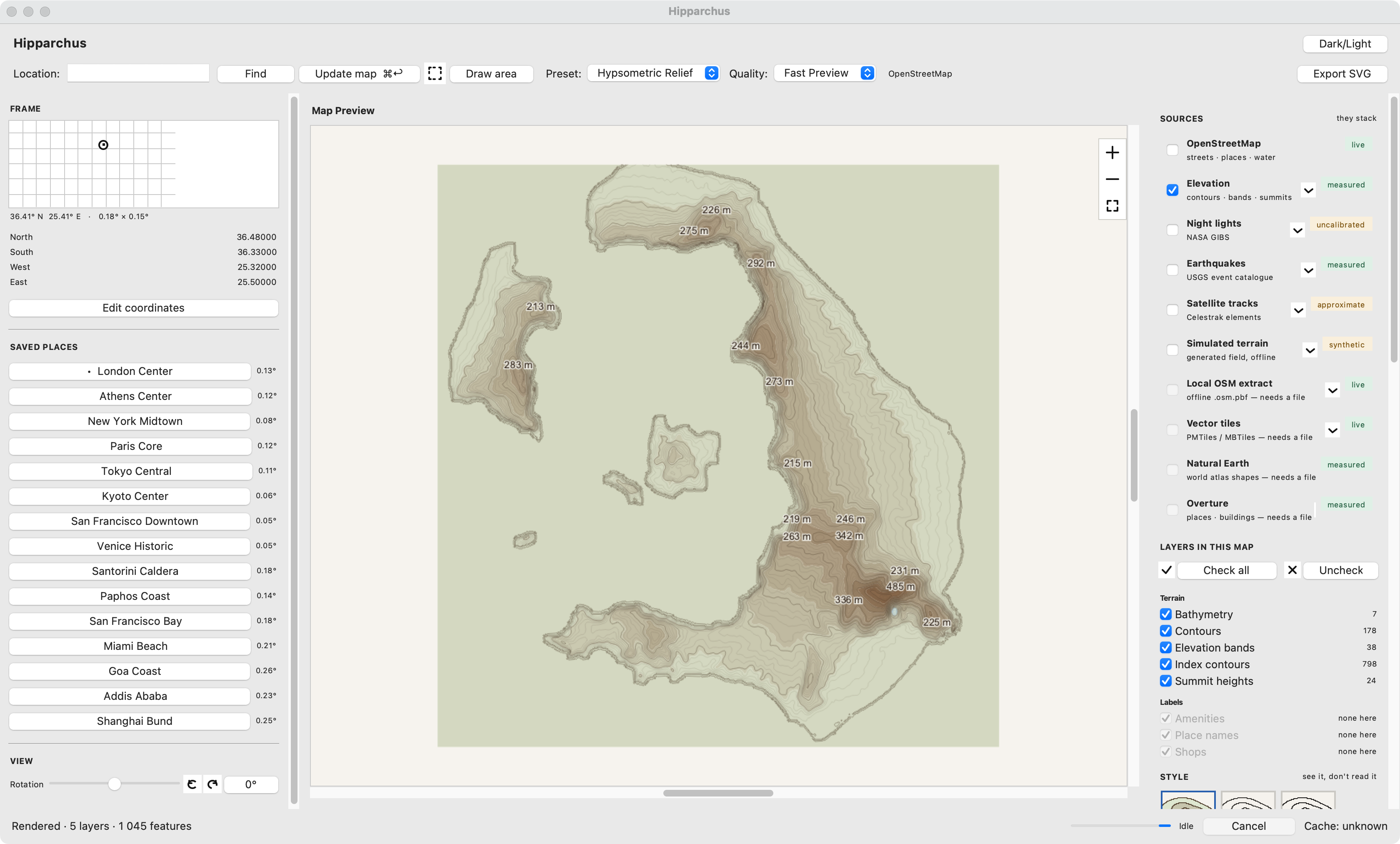
Hipparchus — Santorini, fetched live from OpenStreetMap through Overpass and rendered straight out to layered, editable SVG.
My interest in computer vision is a designer's interest: I want a machine to understand a picture well enough that I can restructure it. Not to classify it, not to caption it — to take it apart along the seams that actually matter and hand me the pieces.
That splits into two halves I keep using together.
Learned vision, run locally. Open-vocabulary detection and segmentation
(GroundingDINO, SAM 2.1, VitMatte) do the semantic layering in
Skiagrafia; a local vision-language model
(Qwen2.5-VL / Qwen3-VL, through either Ollama or llama.cpp) gives
Shapearator its semantic naming, so an
extracted icon lands as heart.png rather than icon_003.png; monocular depth,
subject matting, and SAM 3 region materials give Heron
the scene understanding its physics needs. The constant is that inference is
local and deterministic — model loaders are pinned to local_files_only, and an
engine that reaches for the network mid-render is neither offline nor reproducible.
Classical, geometric computer vision, which is still where most of the work happens: centroidal Voronoi cells, Delaunay meshes, hex grids and circle packing as derived map geometry in Hipparchus; shape detection, cropping and canvas normalization in Shapearator; and in Diastasis the overlap graphs and colouring search that separate tangled vector artwork into production plates — and can prove the layer count is minimal.
And underneath both, colour as a measurable thing: perceptual spaces (Oklab, CIELAB) for ramps that climb monotonically, and Metelli's equations for perceptual transparency in Garau Armonie.
The through-line is simple enough: I want tools that find the structure in a picture, not tools that summarize it.
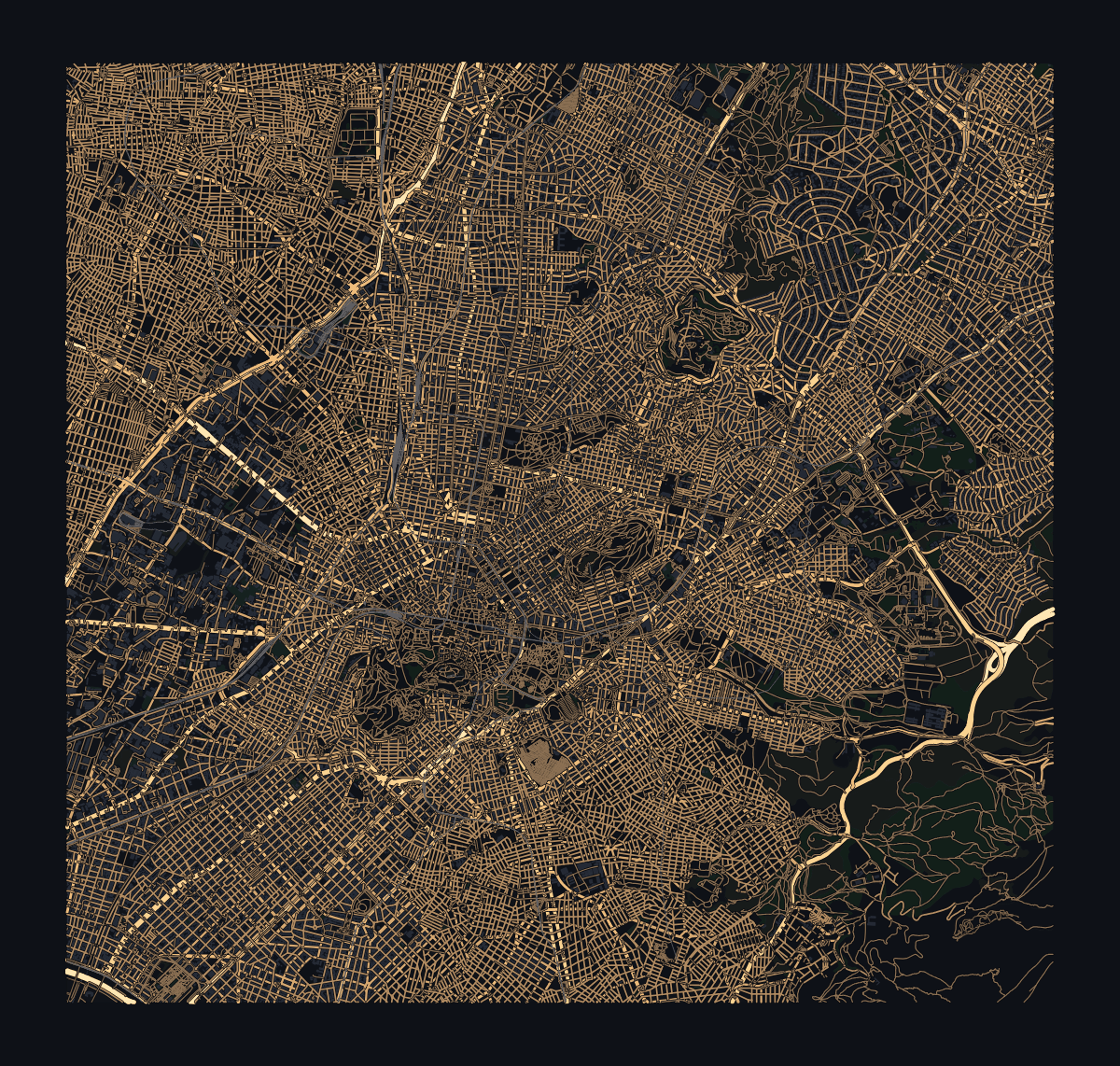 Desktop vector cartography. Live OpenStreetMap through Overpass, local
 .osm.pbf,
vector tiles, Natural Earth, Overture, terrain DEM and VIIRS night lights — out to
layered, editable SVG that opens clean in Illustrator. A shelf of cartographic
presets, plus derived Voronoi, Delaunay, hex-grid and circle-packing geometry.
|
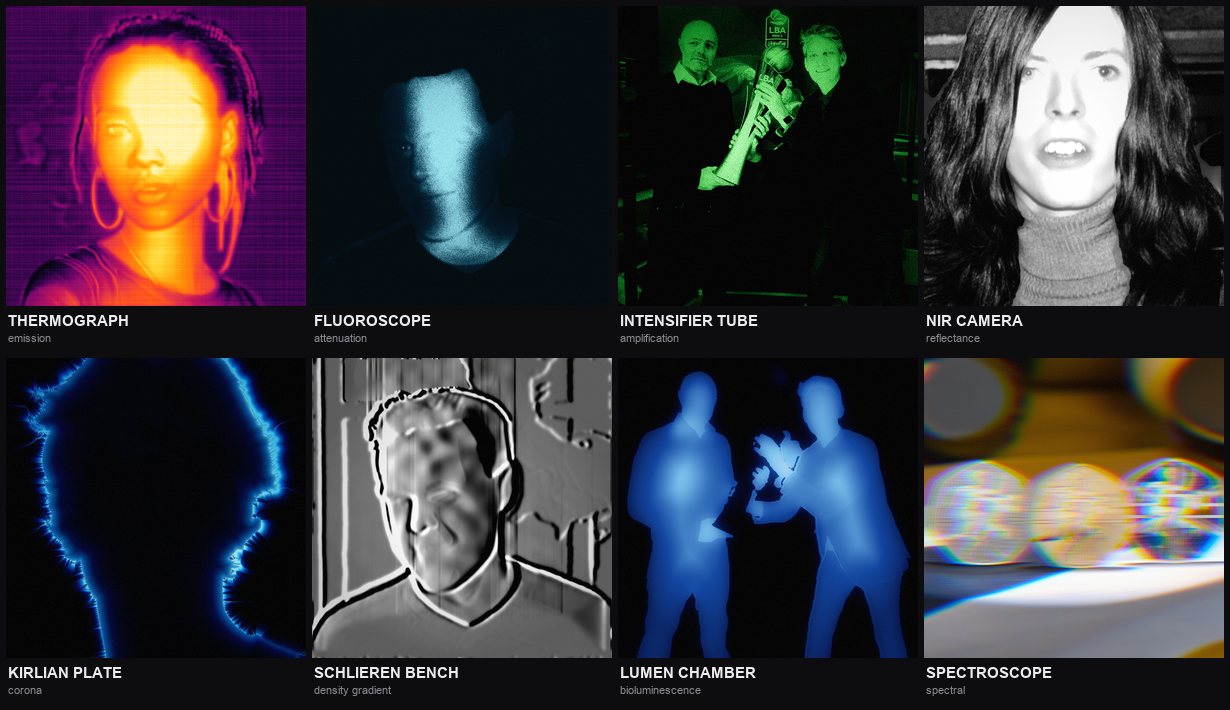 Photographs re-synthesized as if captured by an instrument that sees past human
vision — thermograph, fluoroscope, intensifier tube, NIR, Kirlian plate, schlieren
bench, lumen chamber, spectroscope. Eight physically distinct engines on one
pipeline. A physics simulation, not a gradient map. Artistic simulation — never
a measurement or a diagnostic.
Photographs re-synthesized as if captured by an instrument that sees past human
vision — thermograph, fluoroscope, intensifier tube, NIR, Kirlian plate, schlieren
bench, lumen chamber, spectroscope. Eight physically distinct engines on one
pipeline. A physics simulation, not a gradient map. Artistic simulation — never
a measurement or a diagnostic.
|
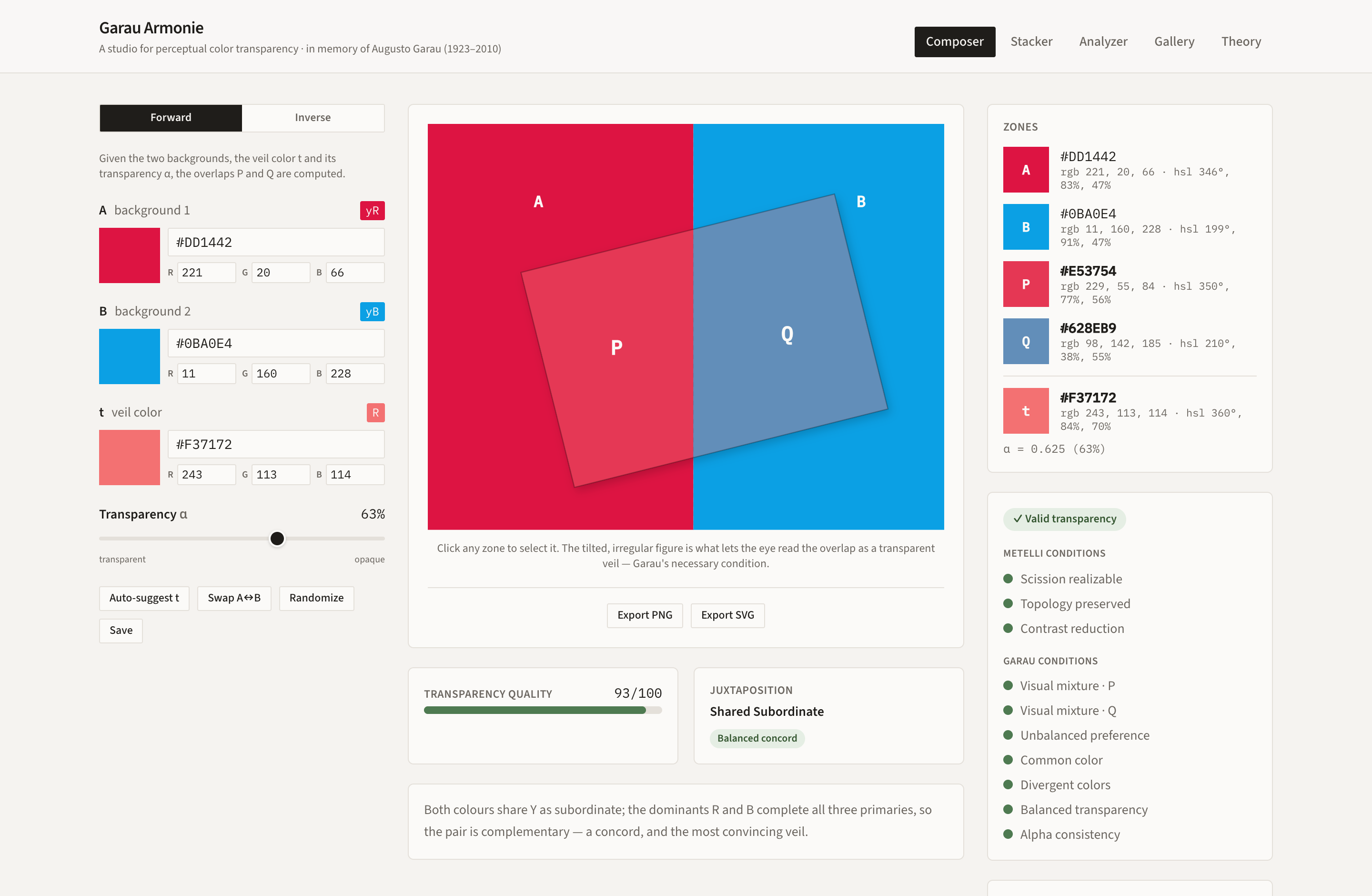 A studio to teach Augusto Garau's colour theory and simulate his perceptual
Colour Transparency, in memory of an unforgettable professor. One
framework-agnostic TypeScript engine drives both a web studio and a Photoshop
plugin, so a colour reads identically wherever you meet it.
A studio to teach Augusto Garau's colour theory and simulate his perceptual
Colour Transparency, in memory of an unforgettable professor. One
framework-agnostic TypeScript engine drives both a web studio and a Photoshop
plugin, so a colour reads identically wherever you meet it.
Live demo → |
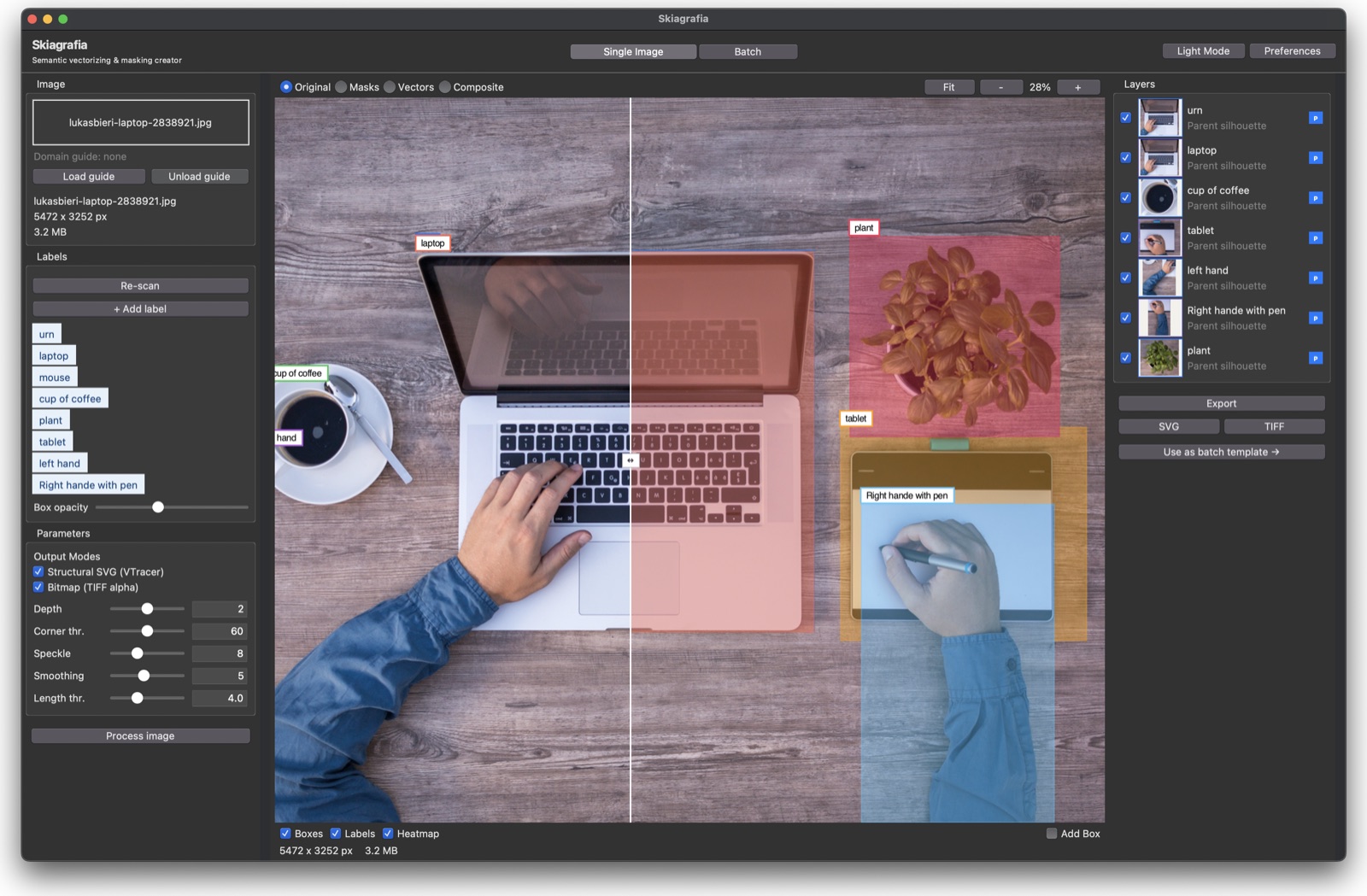 Semantic vectorizing and masking. Local ML segments an image into objects
and their parts, then writes both vector (SVG) and bitmap (TIFF/PNG)
layers. 100% local inference, with a first-run wizard that fetches the weights
so a fresh clone simply works.
Semantic vectorizing and masking. Local ML segments an image into objects
and their parts, then writes both vector (SVG) and bitmap (TIFF/PNG)
layers. 100% local inference, with a first-run wizard that fetches the weights
so a fresh clone simply works.
|
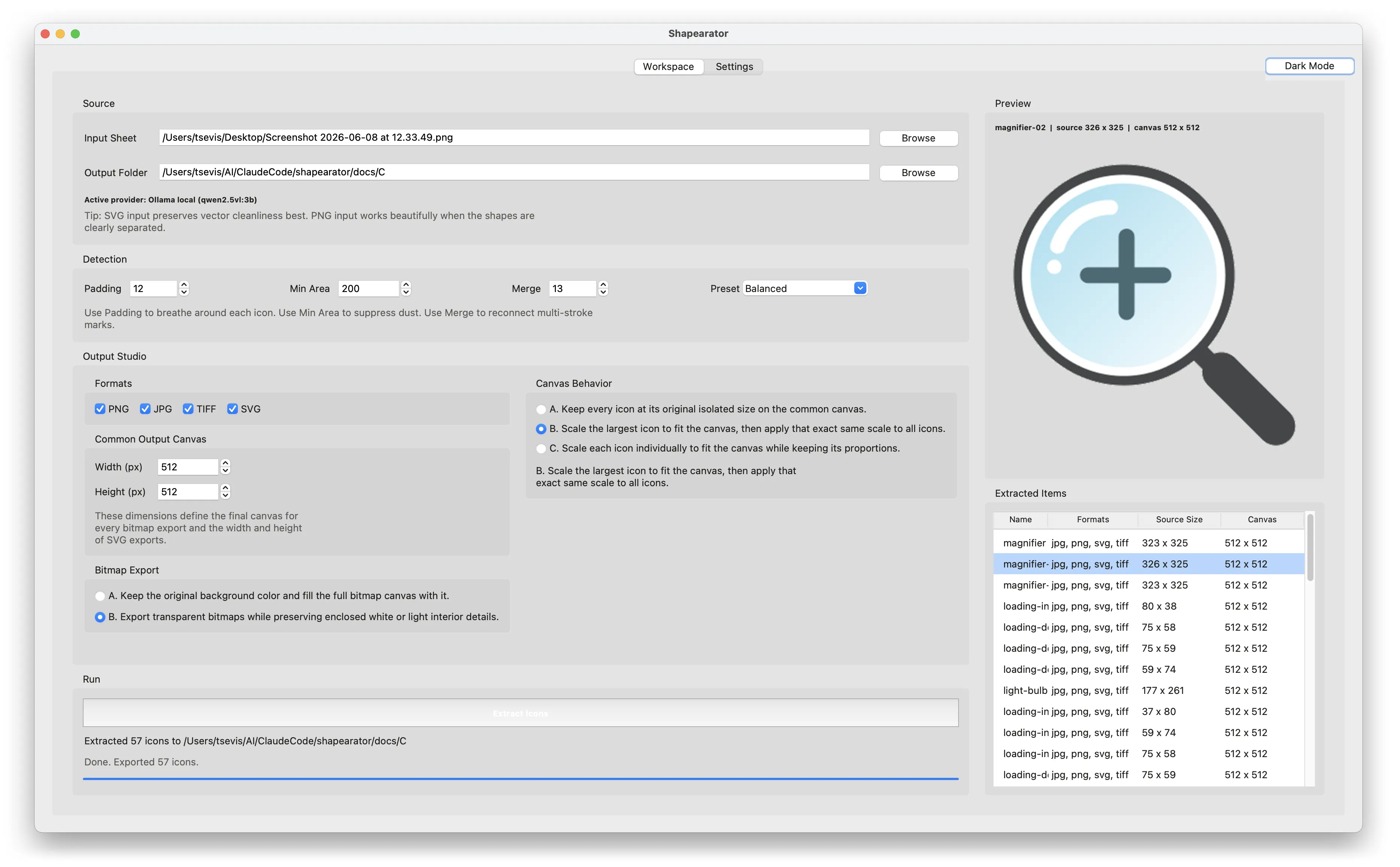 One crowded sheet of shapes in, a tidy library out — each icon detected,
cropped, normalized onto a shared canvas, and exported to PNG/JPG/TIFF/SVG with
per-icon metadata. Ollama and llama.cpp are interchangeable first-class backends
behind a single vision-client contract.
One crowded sheet of shapes in, a tidy library out — each icon detected,
cropped, normalized onto a shared canvas, and exported to PNG/JPG/TIFF/SVG with
per-icon metadata. Ollama and llama.cpp are interchangeable first-class backends
behind a single vision-client contract.
|
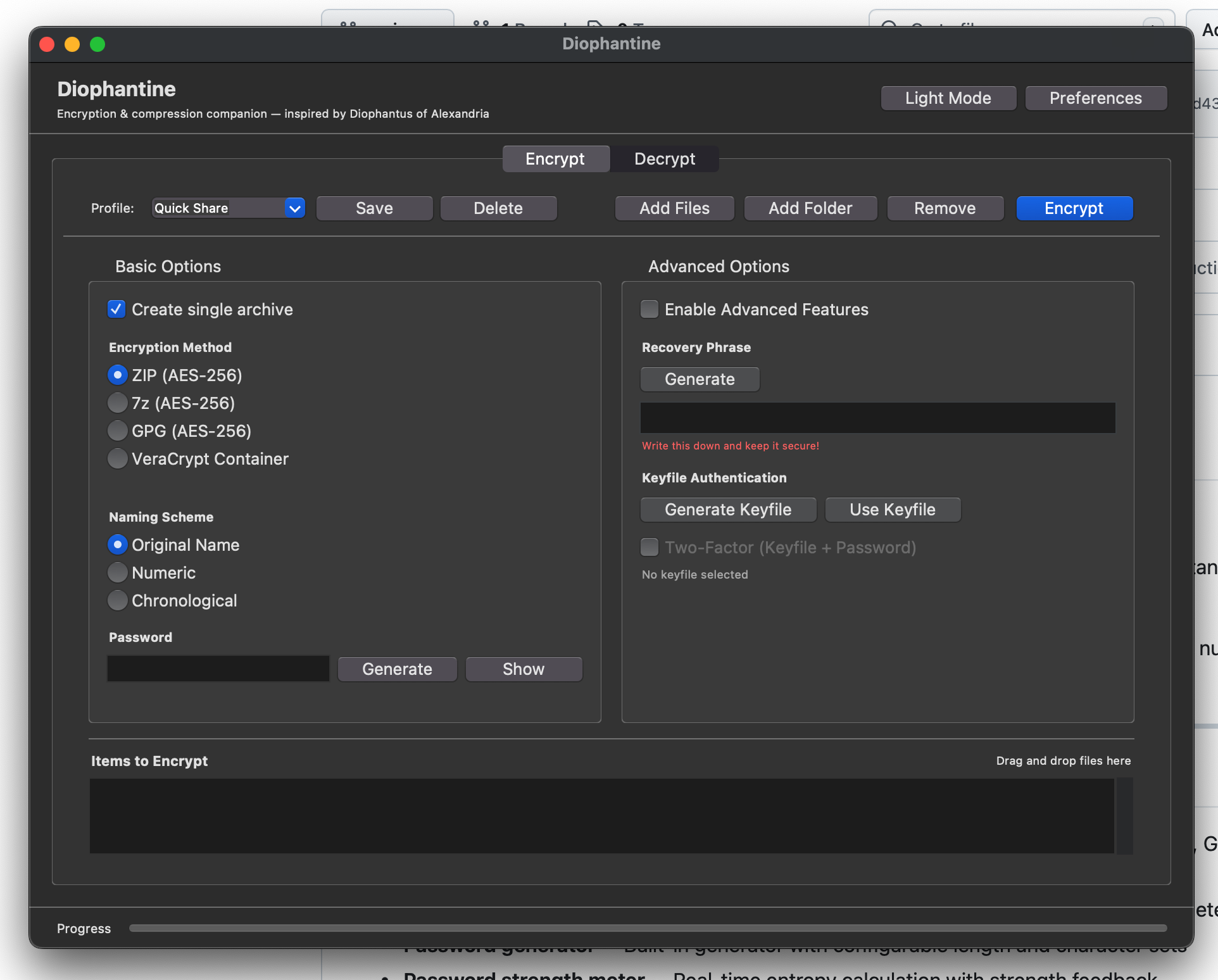 An encryption and compression companion, named for Diophantus of Alexandria.
The one thing here that has nothing to do with pictures.
An encryption and compression companion, named for Diophantus of Alexandria.
The one thing here that has nothing to do with pictures.
|
| Diastasis | Separates complex SVG artwork into production-ready layers — overlap-aware, area-exclusive, or one plate per ink colour for screen-print, vinyl and risograph. The minimum_layers search will tell you when a layer count is provably minimal. |
| MacWhisperer | A macOS GUI for OpenAI Whisper: local transcription and English translation, live recording, device controls, file workflows. |
| IllusionFun | Generates Kitaoka-style diagonal-bevel optical illusion patterns as SVG. |
| crawl4ai-ui | A Streamlit front end for Crawl4AI — pages to clean Markdown, with link/image preview, screenshots and export. |
| gh2ghx | A small Grasshopper file converter. |
Python · NumPy · SciPy · OpenCV · shapely · scikit-learn · PyTorch · Tkinter · skia-python · FastAPI · Streamlit
TypeScript · React · Vite · Adobe UXP
Local inference · Ollama · llama.cpp · SAM · GroundingDINO · Whisper
Output that matters · SVG · GeoTIFF · PMTiles · TIFF